FACEbook

Showing posts with label energy. Show all posts

Sunday, November 9, 2014

Kerry: If U.S. Gave Up All Fossil Fuels, It Wouldn’t Stop Climate Change

    While the nation was focused on the mid-term elections Tuesday, Secretary of State John Kerry spoke at the Johns Hopkins School of Advanced International Studies regarding U.S.-China relations. As he often does, Kerry brought up the subject of climate change, which he asserted is happening "faster and [at a] greater rate than scientists predicted."
    According to Kerry, the U.S. and China are "the world’s two largest emitters of global greenhouse gases," together accounting for "about 45 percent and climbing, unfortunately." And to hear Kerry tell it, the situation almost appears hopeless:
So we need to solve this problem together. Why? Because neither one of us can possibly solve it alone. Even if every single American biked to work or carpooled to school or used only solar panels to power their homes – if we reduced our emissions to zero, if we planted each of us in America a dozen trees, if we somehow eliminated all of our domestic greenhouse gas emissions, guess what? That still wouldn’t be enough to counteract the carbon pollution coming from China and the rest of the world. And the same would be true for China if they reduced everything and we continued. We would wipe out their gains; they would wipe out our gains. 
    Kerry called the recently released United Nations climate report a "wakeup call" that demands "ambitious, decisive, and immediate action":
The UN climate report that was released over this last weekend is another wakeup call to everybody. The science could not be clearer. Our planet is warming and it is warming due to our actions, human input. And the damage is already visible, and it is visible at a faster and greater rate than scientists predicted. That’s why there’s cause for alarm, because everything that they predicted is happening, but happening faster and happening to a greater degree. The solutions are within reach, but they will require ambitious, decisive, and immediate action.
    Kerry sees climate change as "not just an environmental threat but an economic threat, a security threat, a health threat, and a security threat," but he is nonetheless optimistic about solving the problem:
The solution to climate change is as clear as the problem itself. And it’s not somewhere out there, pie in the sky, over the horizon, impossible to grab ahold of; it’s staring us in the face. The solution is energy policy. It’s as simple as that. Make the right choices in your energy policy, you solve the problem of climate change.
    Solving the problem, Kerry says, has the added bonus of creating tremendous wealth, not just for the United States and China, but for the whole world:
Guess what? You also happen to kick your economies into gear. You produce millions of jobs. You create economic opportunity unlike any that we have ever known, because the global energy market of the future is poised to be the largest market the world has ever known. Between now and 2035, investment in the sector is expected to reach nearly $17 trillion. The market that made everybody wealthy in America – everybody saw their income go up in the 1990s, and the greatest wealth in the history of our nation was created in the 1990s... [W]ith a few smart choices, together we can ensure that clean energy is the most attractive investment in the global energy sector and that entrepreneurs around the world can prosper as they help us innovate our way out of this mess and towards a healthier planet.
    Despite Kerry's enthusiasm for working together with China to reduce greenhouse gas emissions, the furthest China has been willing to go so far is to say the country will seek to cap emissions "as soon as possible."


Note: A version of this post first appeared at The Weekly Standard.

Sunday, November 3, 2013

Energy Dept. Seeks Company to Turn Sunshine Into Gasoline

    Although CO2 has a bad reputation as a "greenhouse gas" that contributes to climate change, if the Energy Department (DOE) finds partners to capitalize on the research of one of its laboratories, someday cars might run on sunshine.  Technically, cars would run on the product of sunlight, CO2 and water using a "two-step solar thermochemical cycle" developed by the Albuquerque, New Mexico government lab.  The DOE posted the special notice seeking interested companies on the Federal Business Opportunities website on Tuesday:
Sandia National Laboratories (Sandia) is conducting ongoing research and development into solar fuels, the conversion of sunlight, CO2, and H2O into high energy density, gasoline, diesel, and jet fuel pre-cursors...
Sandia is seeking a company or companies interested in this unique opportunity which will lead to the demonstration and deployment of this technology. 
    Researchers have been working on this idea for some time according to a 2007 press release from the Sandia lab.  At that time, one of the researchers speculated that although a prototype of a device to carry out the chemical process was already under development, it was "a good 15 to 20 years away from being on the market."  The special notice released this week did not contain a timetable, but did note that companies interested in the project "must have a significant interest in developing this technology to the demonstration and deployment stage."


Note: A version of this article first appeared at The Weekly Standard.

Thursday, October 17, 2013

Gov't Shutdown Didn't Stop the Energy Department's Solar Decathlon

    The past two weeks have been filled with stories of government offices, agencies, services, workers, monuments, websites, memorials and parks that have been closed, suspended, furloughed and even barricaded.  Perhaps the most notorious of the actions taken has been the barricading of the open-air World War II memorial in Washington DC, where veterans, some in wheelchairs, who had flown in on "Honor Flights" were denied access.  But one government sponsored-event that was spared the impact of the shutdown was the Department of Energy's 2013 Solar Decathlon, last held in 2011.  The event's website (a .gov site) describes the competition:
The U.S. Department of Energy Solar Decathlon challenges collegiate teams to design, build, and operate solar-powered houses that are cost-effective, energy-efficient, and attractive. The winner of the competition is the team that best blends affordability, consumer appeal, and design excellence with optimal energy production and maximum efficiency.
    There was some concern at the outset of the government shutdown that the event, scheduled for October 3-13, would be affected, but a post dated October 1 on the event's blog allayed such fears.  And not only would the event continue, but federal employees would be allowed to participate [emphasis added]:
Despite the government shutdown, the U.S. Department of Energy Solar Decathlon 2013 competition will continue as planned. 
The Solar Decathlon is funded by a mix of last year’s federal funding and at least 30 private-sector sponsors. Student teams from across the country and around the world have worked for two years to design and build their solar-powered, energy-efficient houses and have been working onsite for the past week to prepare for this highly-anticipated event. Federal employee participation is limited to personnel necessary to allow the show to proceed.
    Not all activities of the Department of Energy (DOE) escaped the effects of the shut down.  The main website of the DOE currently contains the following notice:


    The website for the Solar Decathlon, run by the DOE, however, was updated more than a dozen times during the last two weeks, as recently as Monday, October 14:

    With the National Park Service trying to cut off access to even privately owned and run facilities such as Mt. Vernon and the Claude Moore Colonial Farm due to tenuous government connections, it is difficult to see how a non-essential government competition such as the Solar Decathlon, even with its partial private funding, managed to be carried off and even include limited federal government employee participation.  The Obama administration's commitment to its environmental agenda is strong indeed if a solar-energy competition is elevated above veterans' access to war memorials.  In this case, it appears "green" trumped red, white and blue.


Note: A version of this article first appeared at The Weekly Standard.

Tuesday, August 13, 2013

Fossil Fuel Production on Federal Land Down 4% in 2012

    The U.S. Energy Information Administration reports today that sales of fossil fuels produced on federal and Indian land continue to decline, dropping 4% in fiscal year 2012.  The slide continues a decade-long trend that accelerated in 2010, as the chart accompanying the report shows:


    The report explains:
Sales of fossil fuels from production on federal and Indian lands in fiscal year (FY) 2012 dropped 4% from FY 2011, according to data from the Department of the Interior compiled and summarized in a recent EIA report. This decline was largely driven by declines in offshore oil and natural gas production and coal production. In 2012, sales of fossil fuels on federal and Indian lands accounted for about 27% of total fossil fuel sales in the United States.
In FY2012, sales from production on Indian lands of crude oil and lease condensate, natural gas plant liquids (NGPL), natural gas, and coal ranged from 3% to 6% of the totals from federal lands. Since FY 2003, fossil fuel sales volumes on federal and Indian lands dropped 15%, driven by declines in offshore natural gas production and to a smaller extent by offshore oil production. However, that decline was outweighed by the 27% increase in fossil fuel production on nonfederal, non-Indian lands from 2003 to 2012, so that total U.S. fossil fuel production increased 11% over that period. 
    In June, the Obama administration expressed opposition to the Offshore Energy and Jobs Act introduced in the House by Rep. Hastings (R-WA) that "would require the Department of the Interior to open a number of new areas on the OCS [Outer Continental Shelf]."  The White House said that its opposition was based on, among other things, the legislation's lack of
Secretarial discretion to determine whether those areas are appropriate for leasing through balanced consideration of factors such as resource potential, State and local views and concerns, and the maturity of infrastructure needed to support oil and gas development, including response capabilities in the event of an oil spill.

Note: A version of this article first appeared at The Weekly Standard

Tuesday, June 25, 2013

'War on Coal': Exports Doubled During Obama's First Term

    While Daniel P. Schrag, White House climate adviser, is telling the New York Times that "a war on coal is exactly what's needed," so far the Obama administration has been a boon for US coal exports.  Last week, the Department of Energy reported that coal exports have more than doubled during President Obama's tenure, and exports to Asia went from 2% of the total to 25% from 2007-2012:


    While US exports still make up on a tiny sliver of Asia's coal imports (less than 4%), that is up from almost nothing in 2007, and if anything, the trend has accelerated in 2013, as the report notes:
Growing coal exports to Asia contributed to the all-time monthly record for total U.S. coal exports in March, accounting for more than half of the total growth over March 2012 exports...
...exports to China of U.S. metallurgical coal during the first quarter of 2013 were more than double their 2012 level...
    The report concludes that several factors including demand, U.S. port infrastructure, and the cost of U.S. coal will impact the future growth of U.S. coal exports:
Despite recent growth, U.S. coal exports remain a relatively small source of supply to the Asian coal markets. It faces strong competition from other suppliers to the region, especially Indonesia, Australia, South Africa..., Canada, and Russia... Future growth of U.S. coal exports to Asia will depend upon the pace of Asian coal demand growth; expansion of U.S. port infrastructure, especially on the West Coast; coal pricing in Asia; and the cost of U.S. coal landed in Asia compared to that offered by other major coal exporters.

Note: A version of this article first appeared at The Weekly Standard

Wednesday, January 16, 2013

Presidential Memo Expands the Definition of "Federal Law Enforcement Agencies"

    As part of the president's 23 "executive actions" on gun violence, a presidential memo was issued regarding firearms tracing in connection with criminal investigations.  The memo instructs that:
Federal law enforcement agencies shall ensure that all firearms recovered after the date of this memorandum in the course of criminal investigations and taken into Federal custody are traced through ATF at the earliest time practicable. Federal law enforcement agencies, as well as other executive departments and agencies, are encouraged, to the extent practicable, to take steps to ensure that firearms recovered prior to the date of this memorandum in the course of criminal investigations and taken into Federal custody are traced through ATF.
    However, another provision defines which agencies are included in "Federal law enforcement agencies":
(e) For purposes of this memorandum, "Federal law enforcement agencies" means the Departments of State, the Treasury, Defense, Justice, the Interior, Agriculture, Energy, Veterans Affairs, and Homeland Security, and such other agencies and offices that regularly recover firearms in the course of their criminal investigations as the President may designate.
     This is a pretty sweeping definition compared to the Justice Department's definition:
A federal law enforcement agency is an organizational unit, or subunit, of the federal government with the principle functions of prevention, detection, and investigation of crime and the apprehension of alleged offenders.  Examples of federal law enforcement agencies include the U.S. Customs and Border Protection, Federal Bureau of Investigation (FBI), the Secret Service, and the Bureau of Alcohol, Tobacco and Firearms (ATF). 
     Since the memo also addressed "other executive departments and agencies," it is unclear what this partial deputizing of other agencies as "law enforcement" means.  Perhaps further examination of other executive actions on gun violence will make this more clear.

Tuesday, May 8, 2012

Seen Being Green


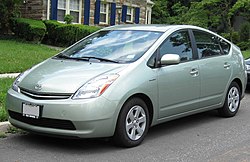
    Last night, I was listening to a Freakonomics podcast that turned out to be from last summer.  The main segment of the show is about “conspicuous consumption” as relates to drivers who like to be seen in their Priuses more for the optics than for the actual energy savings, but it’s the short anecdote right at the top of the show that really grabbed my attention:
Economist Tim Harford of London:  “Now it turns out wind power can be pretty effective. But you need a really, really big windmill in a really windy location to be efficient. These little windmills, especially in an urban environment, where you don’t get a consistent flow of wind, they generate an incredibly small amount of energy. Really, really ineffective. Indeed, there’s a fantastic example from the British physicist David MacKay, who points to building-top windmills in Japan that actually have little electric motors in them to keep them spinning around, because otherwise they would look really stupid on top of the building and not actually moving. So, these windmills actually cost energy.”
It makes me wonder how many people with hybrid cars might actually just fill them with gas and drive them that way rather than bother to plug them in every night.  They'd still get the benefit of being seen driving a hybrid with its clean-energy aura, but without the fuss of remembering to recharge the battery.  Let's face it: when you've got a cell phone, iPad, Kindle, laptop, and iPod to keep recharged, do you really want to have to remember to plug in your car?  As a public service, I'll publish the confessions of any hybrid owners out there who would like to come clean... so to speak...

Friday, April 20, 2012

Solyndra's Dirty Little Secret

    David Burge of Iowahawkblog tweeted Friday morning that the Solyndra building is up for sale.


  Solyndra is the solar panel maker that infamously and spectacularly failed recently despite heavy support from the Obama administration, both promotionally and financially.  Much has been written about Solyndra's downfall, but the sale of the "green energy" company's state-of-the-art manufacturing facility contains one last bit of irony:


Yes, that's right.  Diesel generators - and they're not burning sunshine.  The diesel generator capacity even exceeds the ~1.2 megawatts capacity of the solar panels that this solar panel manufacturer also has installed.  I guess even to make a green omelet, you still have to break a few eggs.

Tuesday, March 27, 2012

The Pipeline 'Round the World [Updated]

    President Obama has a habit of making grand-sounding claims that shrink under closer examination.  I have previously written of such claims relative to deficit reduction and the cutting of regulations.  In both cases, reality was but a shadow of the president's extravagant language.  Recent remarks in Columbus, Ohio continued the tradition as the president talked about the energy needs of this country and what his administration has done to make sure we have an affordable, reliable, and consistent supply.  At one point, while ticking off examples of the way he has reduced dependence on foreign oil, increased domestic production and opened new areas to energy exploration, he said, "We’ve added enough oil and gas pipeline to circle the entire Earth and then some."  This is an effective word picture since even in the era when we often hear "the world is getting smaller all the time," everyone can still maintain a healthy respect for the a tremendous distance a circuit of the earth covers.
    But what is the context?  The circumference of the earth is about 25,000 miles.  So, if we've added 25,000 miles of pipeline in the past three and a half years (let's say 30,000 to take into account President Obama's "and then some,") how much existing pipeline was there to begin with?  According to a chart on the Department of Transportation website, in 2003 there were 2.3 million miles of existing pipeline.  The president's Pipeline-Around-the-World (and-Then-Some) has added to the total by a whopping 1.3%.  In three and a half years.  That comes to a .37% increase per year, or about 8,500 miles.  Now the word picture becomes a pipeline from Washington DC to somewhere in the Pacific Ocean about 1,000 miles short of Sydney, Australia, in the neighborhood of where the airplane in the TV series Lost went down.
    I have emailed the White House requesting the source of the president's claim, but have not yet heard anything.*  Perhaps the President is referring to a certain kind of pipeline that would make the progress of the last 42 months seem more significant.  Or perhaps this rate of progress in adding pipeline is typical under current environmental and regulatory conditions.  Or even better than typical.  However, the president's penchant for vague but impressive sounding delineations of his administration's accomplishments lead me to believe the portrait he has painted owes a great deal to artistic license.  To put the president's annual pipeline output in perspective, the distance from earth to the moon is about 240,000 miles.  When one has made five round-trips to the moon, a flight from Washington DC to Australia that ditches in the Pacific Ocean loses much of its allure.

*UPDATE:  I have now received a response from the White House in the form of a 700+ word letter from President Obama.  However, imagine my disappointment when I discovered I was not the only one to receive such a response.  Barry Stevens at his Barry on Energy blog posted a very similar letter from the president that he received in response to a letter he sent in September 2011, and when I say "similar letter" I actually mean "identical."  I guess I should take some comfort in the fact that I got a response in one day while Mr. Stevens waited six months.  However, my disappointment is compounded by the fact that in the 700+ words there is nothing to address the simple question I asked in my email to the White House, "What was the source for the President's statement, 'We’ve added enough oil and gas pipeline to circle the entire Earth and then some.'"

This post (before the update) was originally published on March 27, 2012 at Blogger News Network.

Thursday, March 22, 2012

The Pipeline to Nowhere


    CNN reports today that President Obama will endorse the permitting of the southern half of the controversial Keystone XL pipeline:
President Barack Obama plans to announce in Cushing, Oklahoma, on Thursday that his administration will expedite the permit for the southern half of the Keystone XL pipeline, a source familiar with the president's announcement told CNN.
In January, the Obama administration denied a permit for the 1,700-mile-long Keystone XL oil pipeline, which would stretch from Canada's tar sands development to the U.S. Gulf Coast. That decision was met by persistent Republican criticism that the president has not been doing everything possible to create jobs and combat high gas prices.
Late last month, TransCanada, the company behind the Keystone XL Pipeline, announced it would move forward with the process to build the southern half of the pipeline, which would begin in Cushing - the president's third stop on his two-day energy tour. The White House praised the move.
Senior administration officials would not confirm the president's plan to unveil the effort to cut red tape for the project, though one senior administration official acknowledged the need to deal with the glut of oil in Cushing, where oil from the Midwest hits a bottleneck as it is transported to the Gulf of Mexico.
    It's a far cry from what the pipeline's backers had sought, and the timing of the announcement has led to suspicions that the Obama administration is seeking a way to blunt criticism of the January rejection of the full project.  The recent rise in gas prices also has had the president looking for ways to show that he is trying to help bring down the cost of energy even while claiming a general inability of government to do so.  Needless to say, there will be mixed reactions to this partial permitting announcement.  NPR reports:
What's clear is that Obama's announcement won't be met with cheers from oil executives. The heads of four big energy companies — Continental Resources, Chesapeake Energy, Devon Energy and Sandridge Energy — said as much in an an open letter to the president published in The Oklahoman.
Their message to the president: Approve the entire XL pipeline, now. They write:
"Approval of the entire Keystone XL pipeline should happen now — not after the election. Yes, we are pleased TransCanada decided to build a critical section of the project from Cushing to the Gulf Coast. We note that this section doesn't require State Department approval. However, America's greatest benefit will come when we can transport oil from our best energy partner, Canada, and oil-rich North Dakota and Montana."
    Although most would have to acknowledge some benefit to the partial construction of the pipeline, the section being fast-tracked is only a fraction of the total project.  As the general election season draws near, will the Keystone XL Pipeline turn into the 2012 version of Sarah Palin's support for the Bridge to Nowhere that was resurrected as an issue when she was named John McCain's running mate?  Except in this case, it wouldn't be support for an expensive government project with questionable benefits, but rather the government's lack of support for a private sector project with multiple unquestionable benefits, not the least of which would be thousands of jobs.  The president can only hope that the parallel doesn't catch on.


This post was originally published on March 21, 2012 at Blogger News Network.

Monday, February 27, 2012

EnergyCare

    While reading a Wall Street Journal article recently, I had an epiphany.  President Obama stated recently that there is no "silver bullet" to solve the problem of high gas prices and our energy costs in general.  Unfortunately, the President has not seemed willing to use any of the weapons in our arsenal (domestic drilling, ANWR, off-shore drilling, fracking, Keystone XL pipeline) to stand in for the mythical silver bullet.  Presently, the administration's energy policy seems to lack even a silver lining, much less a bullet.
     Here's where my epiphany comes in.  Let's have the Energy Department use its regulatory authority to require everyone to buy Energy Insurance.  And I'm not talking about insuring oil rigs or drilling platforms.  I'm talking about peace of mind for the energy consumer, which is, of course, everyone.  (We may have to convince Congress to pass a 2,500 page Commerce-Clause-inspired law first, but how difficult can that be in light of the crisis in which we find ourselves?) After all, Life, Liberty and the Pursuit of Happiness in the 21st century are empty platitudes without the Right to Energy.  And with the volatility of energy prices these days, household budgets are already overextended.  Now that ObamaCare has taken care of Americans' concerns about healthcare, EnergyCare is the next logical step.
    There is a slight glitch in this plan, that being that there are no consumer-oriented Energy Insurance companies.  But with a few well-placed subsidies, incentives, and a little corporate cronyism, no doubt a vibrant industry could be up and running in a few years.  (If there's one place the president likes to use magic bullets, it's subsidies for start-up industries.)  Once things are humming along nicely, my plan can be implemented.  Executives of the evil Energy Insurance corporations (it goes without saying that they will be evil) can be dragged before Congress and forced to testify about their plans to impoverish Americans. (The impoverishing part seems counterproductive, but it's a necessary step to gin up public support.)  EnergyCare will be the obvious solution.  Everyone will be covered, everyone will have the energy they need, and costs will finally be under control.  Who needs silver bullets?  (Oh, and we'll cut out waste, fraud, and abuse.)
    Now there are some on the left who oppose the use of fossil fuels (with an almost religious fervor) on environmental grounds.  These zealots would not want their money going to provide natural gas or other non-renewables to anyone.  In that case, the Energy Insurance companies would simply be mandated to provide those fuels free of charge to all comers to allow the environmentalists to have a green -- er, I mean clean -- conscience.  Compromise is a beautiful thing.
    Perhaps it is a stretch to call this idea an epiphany since it's a blatant rip-off of ObamaCare, but it works for healthcare, why wouldn't it work for energy?  The Commerce clause is still rather stretched out of shape after having ObamaCare crammed into it, so surely it can hold EnergyCare as well.  After all, health care expenditures make up one-sixth of the U.S. economy.  Energy is only half that.  Who knows what else a benevolent federal government might find room for in there.

Sunday, February 26, 2012

The Return of Al Gore?

    The last time we heard from Al Gore, he was continuing his quest to see the refining and production of carbon-based fuels replaced with cleaner, renewable sources of energy. According to a recent speech by President Obama, Gore (who at times has been characterized as "wooden") has decided to get more personally involved:
    We’re launching a program that will bring together the nation’s best scientists and engineers and entrepreneurs to figure out how more cars can be powered by natural gas, a fuel that’s cleaner and cheaper and more abundant than oil.  We’ve got more of that.  We don’t have to import it.  We may be exporting it soon.
    We’re making new investments in the development of gasoline and diesel and jet fuel that’s actually made from a plant-like substance -- Al G.


Hmmmmm. Maybe I'd better go back and check the transcript.