FACEbook

Tuesday, October 9, 2012

White House Condolence Form Letter in Use Since 2009 [Updated]

    Just weeks after Barack Obama was inaugurated, the following story appeared in the New York Daily News:
WASHINGTON - President Obama has adopted role model Abraham Lincoln's practice of writing deeply personal letters to the families of troops killed in battle. He signs them "Barack." 
Bill Brennan, the father of Marine Lance Cpl. Julian Brennan, said at first he barely glanced at the letter he had received last week. 
"I assumed it was a form letter and then I saw that he had signed it - just 'Barack.' You could tell it wasn't a stamped signature. I was so surprised he signed it with only his first name. We were very touched," the Brooklyn dad said Tuesday.
Without disclosing the details of the letter, Brennan said, "It had some personal mentions about Julian's history. I was inspired to respond." 
An aspiring actor, Julian Brennan, 25, was killed by a land mine Jan. 24, the first U.S. combat death in Afghanistan during Obama's presidency.
Obama has since written to the families of about a dozen troops killed in Afghanistan and Iraq. He handwrites the notes, has an aide type them up and then signs the version to be delivered to loved ones.
Now that his first term in office is nearing its end, it appears that practice may have been short-lived.  A story recently appeared on the website Click2Houston.com describing the disappointment expressed by the father of a recently killed Marine over the letter of condolence received from the president:
A man who lost a son to the war in Afghanistan is disappointed in the condolence letter he received from President Barack Obama.
Tom Logan, a Willis resident, calls the note late, impersonal, disrespectful and essentially a form letter.
"It opened up a wound in our heart you can't fix. You can't send another letter. You can't make it right," Logan said.
Logan's son, USMC Cpl. Joseph D. Logan, was killed Jan. 19, 2012, along with five other men when the helicopter they were in crashed.
Joey Logan was 22.
The story links to two letters to families of other service members (here and here) also killed in action.  I have reproduced the body of each letter below:
Letter #1, May 9, 2012

Letter #2, May 9, 2012
Around the end of August, a story appeared, first at the Gateway Pundit, about nearly identical letters received by a numbers of families of service members killed in August 2011.  At the time, there was suspicion that the letters were signed by a machine, but my analysis dispelled that accusation.  However, the letters themselves were indeed form letters just like the May 9, 2012 letters above.

Letter #1, September 23, 2011
Letters #2-#4, September 23, 2011 
Letters #5-#7, September 23, 2011
The latter two images are more difficult to make out, but as far as I can determine, the wording of the final two paragraphs is virtually identical to the others letters above.

    In February 2011, an article appeared on the Austin, TX, Statesmen.com website honoring Marine Cpl. Tevan Nguyen of Hutto, killed in Afghanistan on Dec. 28, 2010.  Although an image of the letter is not provided, the article contains the following quote:
"A simple letter cannot ease the pain of losing a child, but I hope you take solace in knowing that his brave service exceeded all measures of selflessness and devotion to his country," President Barack Obama wrote.
This sentence, of course, comes from the now familiar middle paragraph present in all the other letters above.

    Finally, in November 2009, a long overdue letter from the White House came to the family of Gregg Wenzel, a CIA operative killed in Ethiopia in July 2003.  His family posted the letter online at a site set up to honor this man.  Here we find what may be the prototype for the letter the White House continued to send to grieving families for at least the next two and a half years:

Letter, November 2, 2009

    With more than 1,500 service members killed in Afghanistan since Barack Obama became president, as well as others (such as Wenzel the CIA operative) who have died in the line of duty, the above represents a very small sample of the condolence letters that have gone out from the White House in the last four years.  (President Obama even changed the White House condolence letter policy to include service members who commit suicide while deployed in a combat zone.)  However, I can find no examples of condolence letters that do not fit the pattern of those I have presented here.  If any are brought to my attention, I will gladly link to them.

    The President may have entered office trying to emulate Abraham Lincoln, but soon surrendered to the less labor-intensive and less personal form letter.  For those whose family members have made the ultimate sacrifice for their country, such a letter from the Commander in Chief must be cold comfort.  A President whose campaign currently offers 23 different eCards (topics ranging from the repeal of DADT to the end of the war in Iraq to women's rights) should have found the time to ease the pain of these families with a bit more of a human touch.

UPDATE: I noticed that Jim Hoft at Gateway Pundit actually posted a similar story yesterday around 12:15, about half a day before my story was posted. [I moved this update to the bottom of this post in October of 2017.]

BREAKING: Obama Campaign Encourages Voter Fraud [Updated*]

   This just in: Perhaps in response to his dropping poll numbers, President Obama's campaign has begun openly and brazenly advocating voter fraud!  On Twitter today:


    Come to think of it, this is exactly what caused the Democratic candidate in my home district in Maryland to drop out of the race a few weeks ago.  You'd think they'd have learned their lesson.

*Update: Just so there is no misunderstanding... this is grammar-related satire based on the misplaced modifier.  No election laws were harmed in either the original tweet or this blog post.

Update 2: On second thought, maybe it wasn't a joke.  From Jim Geraghty at National Review today:
Hidden-camera reporters from James O’Keefe’s Project Veritas visit a few Organizing for America offices and find staffers as willing to help folks register to vote in more than one state.

The Sadder But Wiser Girl

    While reading a John Hinderaker post at Powerline on Paul Krugman's attempted takedown of Mitt Romney for lying at last week's Presidential debate, one sentence leaps out at me.  Krugman excoriates Romney for pretending his proposals deal with the problem of pre-existing conditions in relation to medical insurance.  Krugman explains why Romney's free market solutions and limited governmental role is in fact no solution at all:
Also, many Americans have health insurance but live under the continual threat of losing it. Obamacare would eliminate this threat, but Mr. Romney would bring it back and make it worse. Safety nets don’t just help people who actually fall, they make life more secure for everyone who might fall. But Mr. Romney would take that security away, not just on health care but across the board.
    In that single sentence, Krugman gives away the game of the liberals: "Safety nets don’t just help people who actually fall, they make life more secure for everyone who might fall." While in one sense a truism, it is the utopian dream of the left in a nutshell.  Reduce or remove the risks of life so everyone can be more secure.  But universal achievement of that dream can't happen without universal coercion.

    To quote the lyrics from the Sadder But Wiser Girl from The Music Man, "A girl who trades on all that purity, Merely wants to trade my independence for her security." Krugman and other liberals can certainly sweet-talk the issue.  Everyone gives up some freedom so that everyone gets their fair share of security.  The problem is, as it has always been, where does it end?  Once health insurance is guaranteed, regardless of health, what about a house?  What good is health without a place to live?  And food to eat?  And child care?  Maybe even a nice vacation now and again.  Welcome to European Social Democracy.

    Social Democracy is still the Goal That Dare Not Speak Its Name, even among liberals in America.  It's still too soon to be that brazen.  But certainly we are well down that path already, and Obamacare is a huge step further down.  Let us hope that America wakes up and realizes what is happening before she herself becomes that sadder-but-wiser girl, perhaps more secure, at least temporarily, but certainly far less independent.

Monday, October 8, 2012

Sunday, October 7, 2012

Barack Obama: A "New Economic Patriotism"; Not So New

    Since September 27, the President has used the phrase "new economic patriotism" seven times according to White House transcripts of his remarks and speeches.  The most recent was on Friday, October 5th, and was promptly tweeted out by the Obama campaign:


    Much has already been made of the Orwellian sound of the phrase, as well as the audacity of linking patriotism to his own economic policies which are far from universally accepted. The president did not coin the phrase "economic patriotism".  It first appeared in 2005 according to an article at EuroTopics , coined by former French Prime Minister Dominique de Villepin.  It appeared in connection with Barack Obama in the title of an article at The Root back in February 2011, and as recently as August 2012, co-chairman of President Obama’s campaign Ted Strickland hit Mitt Romney for his lack of "economic patriotism."  But the term struck me because of something I read in the recently uncovered course outline of Professor Barack Obama's  Constitutional Law III class at the University of Chicago which I wrote about last Wednesday.

    The Introduction section of the outline, entitled "What is Equality (Thomson)", was apparently based on a rather obscure book published in 1949 by British historian David Thomson called "Equality." Although the book appears to be a general discussion of "equality" and how it has been interpreted over the years in a political context in relation to legal, religious, and economic considerations among others, the term "economic equality" shows up on the first page of the book and appears a total of 32 times in the whole book.  It is noteworthy then that the last point in the Con Law III Introduction outline is:
(10) Centralized Gov’t = development and implementation of egalitarianism.
    For someone who ran for and was elected President of the United States within a decade of teaching this class, this point in the outline seems especially significant in view of where Thomson takes the discussion of equality in chapter 5, which is entitled "Economic Equality."  Thomas writes [emphasis mine]:
Many who would stoutly defend with their dying breath the rights of liberty and equality described above (as would many English or American liberals) shrink back with horror from the notion of economic egalitarianism.  There is no more fundamental task, in any modern discussion of equality,  than to discover why the ideal of equality, so generally accepted in the legal, religious and political arrangements of the modern democratic state, is still so stoutly resisted in its applications to economic life.  Here is the very crux of our whole argument.
    I have not read the whole book (yet), so I cannot say for sure if Thomson is advocating for government-enforced economic equality or just explicating the arguments behind it.  But Professor Obama chose this book as a basis for the introduction for this class on Constitutional Law, so it is not unreasonable to assume it had a significant impact on the development of his views, or at least served to help express those views to his students.  The president famously if inelegantly voiced his views to Joe the Plumber as "spread the wealth around," and now more recently and elegantly as a "new economic patriotism."  But both reflect that final point in the introductory outline above, "Centralized Gov’t = development and implementation of egalitarianism," where equality seems to focus more on outcomes than opportunities.

    When a person swears to defend and uphold the Constitution of the United States, it is reasonable that voters be told what his views are, or were, and how they developed and changed over the years.  When that person actually taught the Constitution in a major university, that information should be widely and readily available.  Instead, information is still surfacing four years after the fact.

    While these views of President Obama are certainly not new or surprising now that we are more than three and a half years into his first term, the fact that this outline and its sources were not available to the American public in 2008 represents yet another failure on the part of the media.  Can this old outline shed light on Barack Obama's call for a "new economic patriotism"?  That largely remains to be seen, but at least now the media and the electorate have one more resource to help make that determination.

Friday, October 5, 2012

Sesame Street is Brought to You by the Letters U, S, and A

    My first blog post to reach a wide audience (thanks, Powerline) was in January 2012 and was titled Nickel and Diming.  The subject was President Obama's plan to save $3 billion over 10 years by combining six government agencies.  Here's how I approached it at the time:
According to the Administration's own budget, total federal expenditures in 2012 will total $3.7 trillion.  In one year.  Even if expenditures were frozen for 10 years (which is about as likely as another old cliche about somewhere freezing over,) the total for the decade would be $37 trillion.    Savings of $3 billion on $37 trillion is the equivalent of a family earning $50,000 saving - are you ready for this? - $4.05.  Yes, that's four dollars and five cents.  I double checked.  President Obama has essentially proposed skipping a Starbucks latte once a year.
    I further noted that the savings amounted to $300 million per year.  The President held a special event in the East Room of the White House to announce his plan, a plan that had its genesis in his 2011 State of the Union address.  The AP reported:
At the time, Obama grabbed attention by pointing out the absurdity of government inefficiency. In what he called his favorite example, Obama said: "The Interior Department is in charge of salmon while they're in fresh water, but the Commerce Department handles them when they're in saltwater. And I hear it gets even more complicated once they're smoked."
    Quite a dog-and-pony show to cut down on the "absurdity of government inefficiency" at a savings of $300 million per year, or about .0081% of the annual budget.  So when Mitt Romney was asked about cutting government expenditures and PBS and Big Bird entered the discussion, absurdity was taken to a whole new level.  Mitt Romney was given two minutes by Jim Lehrer to respond to the question or how he would address the deficit.  After saying that the deficit is a moral issue and enumerating ways to approach it (raise taxes, cut spending, economic growth), Romney decided to give two examples of spending he would go after,  one big and one small (despite the Obama Truth Team's assertion to the contrary).  Obamacare and PBS (or the Corporation for Public Broadcasting.)
Romney: "What things would I cut from spending? Well, first of all, I will eliminate all programs by this test, if they don’t pass it: Is the program so critical it’s worth borrowing money from China to pay for it? And if not, I’ll get rid of it. Obamacare’s on my list... I’m going to stop the subsidy to PBS. I’m going to stop other things. I like PBS, I love Big Bird... But I’m not going to -- I’m not going to keep on spending money on things to borrow money from China to pay for."
    Suddenly, according to President Obama and his campaign, saving the federal government $425 million per year is worthy of ridicule.  The last two days have seen multiple responses (videos, tweets, blog posts) belittling Romney use of PBS as a deficit reduction target.  Does the Obama campaign really want to argue that Sesame Street (which actually does very well via merchandising, thank you very much) is worth borrowing money from China?  The fact that Sesame Street gets only 10% of its funding from PBS only goes to emphasize the campaign's disingenuous righteous indignation towards Romney.  Ironically, Sesame Street is no Solyndra - it could easily stand on its own.  And yet the president is always talking about hundreds of millions in tax breaks going to Big Oil that doesn't need it seems anxious to give the impression that hundreds of millions to Big Bird makes perfect sense.

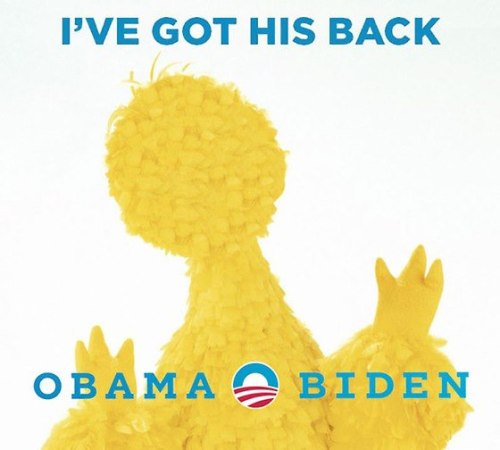
    Come to think of it, why not privatize the PBS and Sesame Street and Big Bird?  Then they could start paying taxes.  After all, in this case, they really didn't build that.  Somebody else did that.  The taxpayers.  We've had Big Bird's back all these years.  Now it's his turn to give back.

Be Careful What You Stipulate

    Today, the Obama campaign tried to paint the Debate Mitt Romney as an impostor.  The Obama Truth Team produced a short video accusing Romney of feigning ignorance of his own $5 trillion tax hike:
Romney falsely claimed his tax plan wouldn’t raise taxes for the middle class, despite the fact that multiple independent experts say that’s the only way he could pay for his $5 trillion tax cut favoring the wealthy:


    Understandably, the Romney campaign objected, and prepared a vigorous response.  However, they needn't have done so.  Stephanie Cutter, Deputy Obama Campaign Manager, how about if you take this one?


    I'll bet the Truth Team didn't see that coming.