FACEbook

Showing posts with label politics. Show all posts

Tuesday, June 2, 2015

Clinton Foundation Meeting in Morocco Last Month Cost Taxpayers $21K

   Bill Clinton, no stranger to controversy, raised eyebrows again with a Clinton Global Initiative gathering earlier in May, as ABC News put it, "at a five-star luxury hotel in Morocco [hosted] by one of the world's most controversial mining companies, criticized for 'serious human rights violations' by the Robert F. Kennedy Center for Justice." And as is the case with every trip a former president takes (and President Clinton takes a lot of trips), the U.S. taxpayer is on the hook for security expenses. For the Morocco trip, the hotel costs alone for the Secret Service came to $21,165:


     Other expenses related to the Morocco trip could not be located on the government spending website, but vehicle expenses likely ran into the thousands of dollars. Last Christmas/New Years, as THE WEEKLY STANDARD reported, a vacation for the Clintons in the Dominican Republic cost the taxpayers over $104,000 in hotel costs alone for the Secret Service. Three contracts discovered after that article was published show that vehicles for the Secret Service for the Clintons' Dominican vacation cost almost $20,000.


Note: A version of this post first appeared at The Weekly Standard.

Monday, May 11, 2015

Hillary Clinton Fundraises Off Mother's Day

   Hillary Clinton wants you to wish her a Happy Mother's Day... and maybe send a few dollars her way, as well. Often, organizations that support politicians or candidates (such as the Democrat or Republican National Committees) will solicit such greetings for holidays and special occasions. But in this case, Hillary Clinton's own campaign isn't leaving it to chance. 
     Potential well-wishers are asked to enter their names, email addresses, and zip codes (not optional):


     Once the contact information is submitted, well-wishers are invited to become donors as well:


     Card signers also receive an immediate email asking for a donation. The email doesn't indicate if it's a one-time contact or if card signers are added [*see update below] to a regular mailing list.


     Flowers are apparently optional.


*UPDATE: On Mother's Day, another fundraising email was received at the address used to sign Mrs. Clinton's Mother's Day card.


Note: A version of this post, before the update, first appeared at The Weekly Standard.

Tuesday, May 13, 2014

From Here to Eternity... Or Election Day, Whichever Comes First

    In James Taranto's Tuesday edition of his Wall Street Journal Online column The Best of the Web, Taranto quotes from a recent article by the Journal's Gerald Seib: "[S]ix months is an eternity in modern politics."  The phrase sounds very familiar to even the casual consumer of political media, but just how hackneyed the formulation has become may surprise even grizzled political veterans.  The Bible tells us in Ecclesiastes 3:11 that God has set eternity in the hearts of men, but clearly eternity is also set in the pens of pundits.  With barely a research effort to speak of, here's an abridged compilation of this most versatile of politics memes:
  • "Fifteen months is an eternity in politics, so Sen. Lautenberg has plenty of time..." Rutgers
  • "Thirteen months is a long time between now and election day. Thirteen months is an eternity in politics." New York Times
  • "...two weeks is a long time in politics, eleven months is an eternity." Canada Free Press
  • "There are also still nine months left in 2014 – an eternity in politics." Breitbart
  • "Eight months is an eternity in politics..." PolicyMic
  • "...seven months away, an eternity in American politics." Bloomberg
  • "Six months is an eternity in modern politics..." WSJ
  • "They say a day in politics is a long time. A little over four months would perhaps qualify as an eternity..." CVMTV
  • "Now we’re under a month to go until the November 6 election, at which point today will seem like an eternity ago." Reuters
    To be clear, I could have gone higher than sixteen months, but since this is not a political campaign, I didn't have eternity to work on it.  And time also fails me to tell of the eternal nature of political daysweeks, and years.
    But the trail leading to the apex of hyperbole doesn't end here. Politico (as reposted by CBS News) managed to squeeze eternity into a single hour back in 2007:
    The grand prize, however, goes to Michael Green writing in the Federal Political News from Joyce Communications in Nevada. Green bests Politico by a factor of sixty:
  • "Much can change in that long a period, since a minute is an eternity in politics." Joyce Communications
    But on second thought, maybe Michael Green was on to something.  After all, many candidates watching returns crawl in on election night could certainly identify with the words of Franz Kafka: "L'éternité, c'est long ... surtout vers la fin." Eternity is long, especially near the end.

Saturday, November 30, 2013

Obama: 'Sometimes People Forget I'm Not Running for Office Again'

    At a stop in San Francisco on a three-day fund raising swing along the West Coast, President Obama said during a speech that "...sometimes people forget I'm not running for office again."  The president was talking about Republicans in Congress and the immigration reform that he is trying to get through the House:
And some of them even forget that I'm -- sometimes people forget I'm not running for office again.  Michelle doesn’t forget.   (Laughter and applause.)  So you don’t have to worry about this somehow being good for me.  This is good for the country.   It's the right thing to do for the American people. 
    A remark the president made at his first stop on the tour, the Seattle home of Jon Shirley, may give some insight into why some forget the president isn't running again:
Well, first of all, let me just thank Jon for the second time for his incredible hospitality.  And I think it’s fair to say that between Nancy and me and Steve Israel, we do a lot of events.  I will say that this particular space is one of the more spectacular venues for an event.
    The president's schedule lists several Democrat party events for Monday alone:


Note: A version of this article first appeared at The Weekly Standard.

Thursday, November 1, 2012

President Obama: I Am The Champion, My Friends

source: bigbadbaseball.
blogspot.com
    A new word began showing up today in President Obama's campaign.  Here's an excerpt from a speech the president gave in Green Bay, Wisconsin:
See, the folks at the very top in this country don’t need another champion in Washington.  They’ll always have a seat at the table.  They’ll always have access and influence.  
The people who need a champion are the Americans whose letters I read late at night; the men and women I meet on the campaign trail every day.  The laid off furniture worker who is retraining at age 55 for a career in biotechnology -– she needs a champion
The small restaurant owner who needs a loan to expand after the bank turned him down -– he needs a champion.  The cooks and the waiters and the cleaning staff working overtime at a Vegas hotel, trying to save enough to buy a first home or send their kid to college -– they need a champion.  (Applause.)  
The autoworker who’s back on the job, filled with pride and dignity because he’s building a great car –- he needs a champion.  (Applause.)  The young teacher doing her best in an overcrowded classroom with outdated textbooks –- she needs a champion.  (Applause.)  
All those kids in inner cities and small farm towns, in the valleys of Ohio or rolling Virginia hills or right here in Green Bay; kids dreaming of becoming scientists or doctors, engineers or entrepreneurs, diplomats or even a president –- (applause) -- they need a champion in Washington.  (Applause.)  They need a champion.  They need a champion because the future will never have as many lobbyists as the past, but it’s the dreams of those children that will be our saving grace.
    Being a politician makes some degree of self-promotion virtually unavoidable.  Candidates often refer to themselves in the third person with phrases such as "America needs a leader who will..."  But the above strikes me as the kind of speech better delivered by a candidate's spouse or by a vice presidential candidate about his running mate.  But to tout one's self as a "champion"?  On the other hand, as the New York Times just recalled in September, perhaps it fits after all:
“I think that I’m a better speechwriter than my speechwriters,” Mr. Obama told Patrick Gaspard, his political director, at the start of the 2008 campaign, according to The New Yorker. “I know more about policies on any particular issue than my policy directors. And I’ll tell you right now that I’m going to think I’m a better political director than my political director.”
    The other message of Obama's "champion" speech is that the days of "ask not what your country can do for you" are behind us.  Now the self-proclaimed Champion in Chief will secure a "seat at the table" in Washington for the 99% (or is it the 47%?) to lobby for their dreams.  America is apparently no longer the land of opportunity unless Barack Obama "makes that happen."  No time for losers, cause he is the champion.

Wednesday, October 10, 2012

Jay Carney, Above the Fray

    Jake Tapper peppered Jay Carney today with questions about last month's terror attack on the US Consulate in Benghazi, Libya.  Tapper was trying to pin down Carney on why the attack was  mischaracterized for so long as a spontaneous demonstration gone violent, when, as the government now admits, it was neither spontaneous or a demonstration.  Carney tried to put things in perspective [emphasis mine]:
Again, this is a moving picture, and people who on the night of an attack or the day after claim they know all the facts without making clear that what we know is based on preliminary information aren’t being straight, and they’re in some cases trying to politicize a situation that should not be politicized. I think that’s what the president was getting at. And I think many other people felt the same way.
After some further back and forth, Tapper's questions concluded with this [again, emphasis mine]:
TAPPER: ...Democrats have talked about budgets being cut for embassy security. And I’m wondering if that’s something that the White House believes was a problem as well, that there was — there had something to do with money being withheld by House Republicans or whomever. 
CARNEY: ...What is simply a matter of fact is that this president has fought for and put forward funding that he believes is necessary for our diplomatic personnel and diplomatic security around the world. And others have sought to reduce that funding over these past several years because of a — of an approach to our budget priorities that prioritizes tax cuts for millionaires and billionaires. That’s just a fact...
Regarding politicization, Carney was channeling Groucho Marx: "Those are my principles, and if you don't like them... well, I have others."

Thursday, September 27, 2012

Change

    In an interview with Univision last week, President Obama made a startling admission (via FoxNews):
Four years after Barack Obama campaigned on a promise of "hope and change," he now is admitting that a president isn't able to change Washington "from the inside" -- an admission that rival Mitt Romney promptly blasted as "the white flag of surrender."
President Obama, at a forum Thursday hosted by the Spanish-language TV channel Univision, lamented the challenge of shaking up the status quo in the capital.
"The fact that we haven't been able to change the tone in Washington is disappointing," Obama said, in response to a question about his greatest failure. "The most important lesson I've learned is you can't change Washington from the inside. You can only change it from the outside."
    Ever since that interview, instead of acknowledging the gaffe, the president has doubled down on his framing of the statement:


    In many ways, this "change comes from the outside" sentiment embodies the president's method of governance.  His modus operandi is decidedly characterized by imposition.  Some in society don't have health insurance?  Make everyone buy it!  Children aren't eating enough healthy foods?  Force every public school cafeteria to conform to strict calorie standards.  Not enough people are buying electric cars?  Give enormous tax credits that force everyone to subsidize those who do buy them.

    The now infamous 2001 interview that Barack Obama did with Chicago Public Radio contains the essence of this philosophy [emphasis mine]:
The Supreme Court never ventured into the issues of redistribution of wealth, and of more basic issues such as political and economic justice in society. To that extent, as radical as I think people try to characterize the Warren Court, it wasn’t that radical. It didn’t break free from the essential constraints that were placed by the Founding Fathers in the Constitution, at least as it’s been interpreted, and the Warren Court interpreted in the same way, that generally the Constitution is a charter of negative liberties. Says what the states can’t do to you. Says what the federal government can’t do to you, but doesn’t say what the federal government or state government must do on your behalf.
    Change from the inside is apparently too hard to control and takes too long.  Short term satisfaction can be achieved through raw power rather than persuasion.  But it is rare to hear someone so publicly and blatantly disparage what is almost a truism about the superiority of internal versus external change.
Not all cliches are bad, and although it sounds trite, true and lasting change must come from the inside.  This goes for Washington and politics as well.  Our founders often warned that our Constitution and system of government would only function well under people of character.  Until the people in politics and Washington change, no amount of Hope and Change from the outside will make a difference.

Monday, April 9, 2012

Chesterton the Pundit

    This comes under the heading of "nothing new under the sun."  Remember all the denunciations of "violent" imagery and rhetoric over the past few years?  Sarah Palin was called out for using "target" symbols on a campaign map... and then it turned out the Democrats had used similar graphics elsewhere.  After Congresswoman Gabrielle Giffords was shot by some lunatic, many media figures and politicians blamed the "right" for using language that inflamed passions to such a degree that things like this were bound to happen.  As it turned out, the lunatic was left-leaning if anything in his delusions, and on top of that, a little research showed that many of the denouncers used identical words and metaphors they were now decrying.  This even included President Obama with his infamous "if they bring a knife to the fight, we bring a gun" line.
    So it was quite funny to run across the following as I was reading G.K. Chesterton's The Man Who Knew Too Much.  Horne Fisher, the hero of the stories, is visiting a political operative of Fisher's opponent in a contest for a seat in Parliament.  Mr. Gryce would be a familiar face on cable TV were he around today:

"Mr. Horne Fisher, I believe," said Mr. Gryce.  "Much honored by the call, of course. Can't pretend to congratulate you on entering the contest, I'm afraid; you won't expect that. Here we've been keeping the old flag flying for freedom and reform, and you come in and break the battle line."
For Mr. Elijah Gryce abounded in military metaphors and in denunciations of militarism. 
Could there be a more concise yet devastating blow against the political hypocrisy we witness today?  Chesterton wrote this in 1922.  I do not always share Chesterton's views, but I find his writing as sharp as Twain and Wodehouse.  And thanks to Project Gutenberg, the price can't be beat.

Sunday, March 11, 2012

Sausage, MSM, and Redistricting

    The state of Maryland recently went through a somewhat contentious redistricting process to determine the new boundaries for Congressional districts based on the 2010 census.  Every state has either gone through the same process or is currently doing so.  Given that population shifts are constantly occuring and populations are rarely if ever spread uniformly throughout a state geographically, the process is sometime tedious and, depending on the political climate in a given state, more often than not, controversial.
    According to the Census Bureau, whose work is responsible for producing the data used to determine Congressional district boundaries, "[e]ach congressional district is to be as equal in population to all other congressional districts in a state as practicable."  How states accomplish this varies widely.  The federal constitution is silent on the matter, only providing the census as a means of apportioning Representatives among the states, not determining how those representatives are chosen.
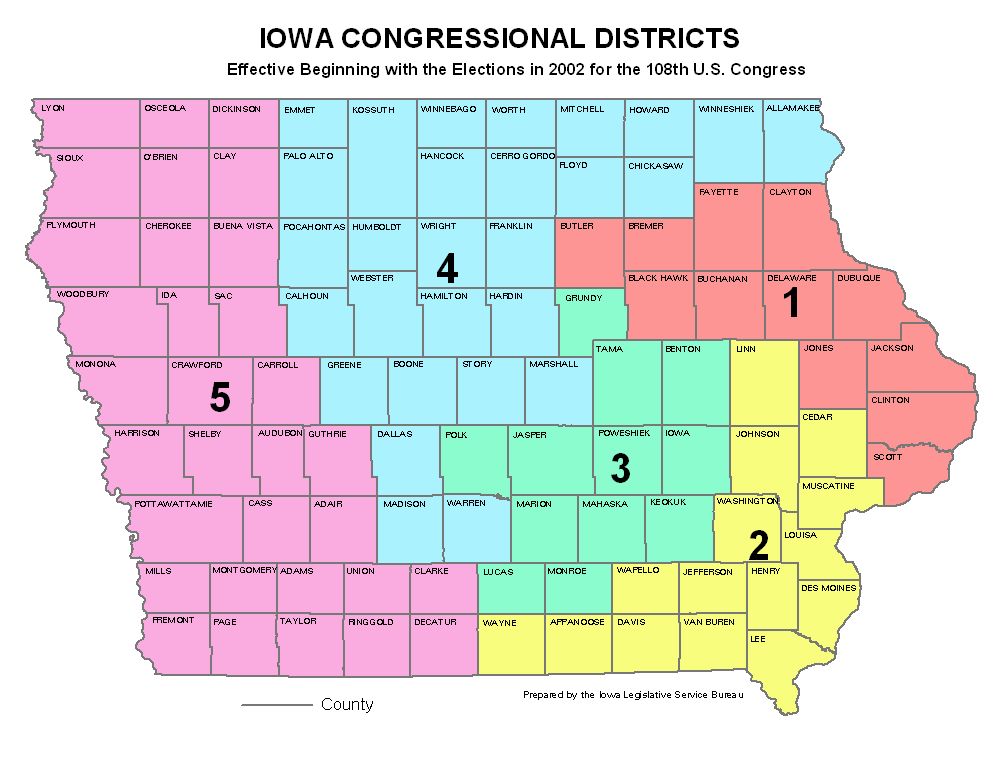
    Some states have chosen to use their counties as a means of drawing district boundaries, such as Iowa, shown here:

Oklahoma follows this system as a general rule, although some county lines and Congressional district lines diverge:

And then there's Maryland...


There are those who would argue that the relatively small size, the shape, and large population of Maryland does not lend itself to the tidy and relatively simple configurations achieved by states such as Iowa and Oklahoma.  But it is difficult to look at the outcome and not have other images come to mind.  Given the recent attention paid to the much reviled MSM (no, not "main stream media" - that other reviled MSM, mechanically-separated meat,) this is the mental picture of the process that I see:


(Hat tip to Tail 'o the Rat for the photo)

Although as the Washington Post helpfully points out, this photo (or I should say the non-rainbow original) is actually mechanically-separated-chicken, but chicken is meat in my book, so there's no need to split hairs.
    Otto von Bismarck is credited with observing, "To retain respect for sausages and laws, one must not watch them in the making."  I would add "Congressional districts" to the list, but just to be safe, one might not even want to see them when they are done.

Saturday, March 10, 2012

Forward... or Back... to the Dark Ages!

During the debate in the Senate this week on the Blunt amendment, Senator Frank Lautenberg (D-NJ) stretched the bounds of reason with the following hyperbolic riff:
“The Republicans want to take us forward to the Dark Ages again … when women were property that you could easily control, even trade if you wanted to,” Lautenberg said. “It’s appalling we are having this debate in the 21st century.”
And today, James Taranto in his column at the Wall Street Journal noted another voice chiming in with similar rhetorical overkill.  The Orwellian-named Freedom From Religion Foundation (FFRF) ran an ad in the New York Times that was noted by Catholic League president Bill Donohue:

Never has there been a more vicious anti-Catholic advertisement in a prominent American newspaper than the one in today’s New York Times by Freedom From Religion Foundation (FFRF) ... Here is how the ad begins: “It’s time to quit the Roman Catholic Church. Will it be reproductive freedom, or back to the Dark Ages?”
 Leaving aside the embarrassing lack of harmony in their diatribes (is it "forward to" or "back to" the Dark Ages?), is this kind of over-the-top polemic actually intended to change minds?  Is this what President Obama had in mind when he said at his Tuesday press conference:

We want to send a message to all our young people that being part of a democracy involves argument and disagreements and debate... [a]nd we want you to be engaged, and there's a way to do it in a way that doesn't involve you being demeaned and insulted.
Reading the entire FFRF ad does nothing to restore one's faith in the legendary "civility" for which the president continues to call.  It appeared this week that Robert F. Kennedy Jr. missed the civility memo as I noted earlier this week.  But if you can endure to the end of FFRF's ad, you will be rewarded with some delightful irony.  For those wishing to donate to the cause, a membership application with a listing of dues is provided at the bottom.


There are various levels available starting with $25 for a student.  A lifetime membership will set you back $1,000.  But if you really want to make a stand against religion, plunk down $5,000 and the "After Life" membership is yours.  Is it just me, or does that smack of the Catholic innovation during the Dark Ages of selling indulgences?  Apparently what the FFRF lacks in civility they make up for in nerve.

Friday, February 10, 2012

President Obama's Two-Pronged Assault on Religious Freedom

    The frontal assault on the freedom of religion that the new mandatory health insurance coverage rules from HHS represent is serious enough, but religious institutions find themselves in danger of a potential flanking attack as well.  Churches and their subsidiary institutions are right and justified in their opposition to the new rules which require violation of deeply held convictions regarding abortion and birth control.  Ironically, publicly expressing that opposition, normally considered a first amendment right to free speech, could place these institutions in further jeopardy from the government.
    Most religious institutions are by nature non-profit and thereby tax exempt under Section 501(c)(3) of the IRS code.  One of the requirements to maintain this tax exempt status is to refrain from engaging in substantial political activity and attempting to influence legislation.  Churches and religious leaders must at least consider the effects of their words and actions in the political arena.  Sometimes the line is blurry and a decision must be made about whether the religious and moral principles involved justify the risks associated with public statements on legislation or the actions of politicians.
    What is unique in the current imbroglio is that the policy in question is not a broad cultural issue, but rather is aimed directly at the religious institutions themselves.  In order to fight back, these institutions will have to devote more time, energy and resources to be effective.  This will inevitably invite more attention from the IRS, especially since the "substantial" standard is undefined even by the courts.  The more vocal and persistent an organization is in opposition to the new HHS rules, the more it jeopardizing its tax exempt status, or at the very least is inviting increased scrutiny.
    In a perverse way, the Obama administration has every incentive to prolong the controversy, as the "accommodation" being announced today seems destined to do, because opposition groups will be in effect handing the IRS the rope on which to hang them by continuing their efforts to "influence legislation."  Religious institutions are finding themselves increasingly faced with a dilemma: acquiesce to the administration or endanger their tax exempt status.  This is an affront to the "free exercise" promised by the First Amendment, and should be an embarrassment to the President who swore to uphold and defend the Constitution.

Thursday, February 9, 2012

Obamacare vs. the Sadder-but-Wiser States

  This spring, the Supreme Court will hear arguments on the constitutionality of the Affordable Care Act, also known as Obamacare, in a suit brought by 27 of the 50 states.  While liberals are largely galvanized in their support for Obamacare, conservatives are not uniformly lining up behind the states' case.   Michael Greve of the American Enterprise Institute recently wrote about two primary issues on which the court will rule: the "individual mandate," a subject of increasing debate among conservatives, and the expansion of Medicaid.  While Mr. Greve is almost dismissive of the impact of the first issue either way it is decided, he is unequivocal about the latter:  "However, the states won’t prevail on their Medicaid claim.  Nor should they."  While conservatives might disagree about whether or not the states will prevail, we should be unanimous in our conviction that they should.
   Throughout Mr. Greve's essay is an undertone of you-asked-for-it relative to the states and the federalism balance.  While he makes a good case that foolish decisions have led to entanglements for the states that call their sincerity into question, his conclusions are less convincing.  He frames the plaintiffs' case this way: "Constitutionally, the states’ brief hangs its opposition on a single sentence in the Supreme Court’s 1987 decision in South Dakota v. Dole...," and then proceeds to discuss how much money is involved, what constitutes coercion, and the states schizophrenic opposition to both funded and unfunded federal mandates.  But does past acquiescence to unconstitutional programs or statutes impair the right to contest the further expansion of those programs or statutes?  To look at it another way, should citizens on welfare, for example, be expected to have diminished rights to free speech or trial by jury because welfare programs over time have become "bigger and more generous?"  This is nothing more than a creeping tyranny by government largess on the installment plan.
   Perhaps he is just being pragmatic, but Mr. Greve even goes on to say that "...the states do not come to the table with clean hands."  But even a suspect with a long criminal record does not forfeit constitutional protection for lack of "clean hands."  Besides, the Supreme Court is not a "table" at which to plea-bargain.  It is a court of law.  Just as prosecutors are routinely barred from raising the issue of prior convictions of the defendant during a criminal trial, so the states checkered past should not tip the scales of justice.  In the Obamacare case, the states may be thought of as the sadder-but-wiser girl who wants a fair shake from the court despite her youthful indiscretions, and the court is obligated to grant just such an unbiased hearing.
    Conservatives must not continue to surrender to the Whisper-Down-the-Lane jurisprudence that has led to the caricature of constitutional law that currently dominates our legal system.  Precedent based on precedent based on precedent with a little legislative overreach thrown in for good measure, and soon any federal government program can be made to look reasonably constitutional.   But if the founding fathers had imagined that federal legislation with the breathtaking scope of Obamacare could someday be squared with their concept of limited government, they would have tossed their drafts of the Constitution in the bottom drawer with their old copies of the Articles of Confederation and sent James Madison back to Montpelier to try again.

Tuesday, February 7, 2012

Term Limits! For Taxes...

    Today, Ben Bernanke addressed the Senate Budget Committee and urged them not to let the Bush tax cuts expire.  Sunday, New York mayor Michael Bloomberg said on Meet the Press that the Bush tax cuts should be allowed to expire.  In mid-January, Council of Economic Advisers Chairman Alan Krueger said that not only should the Bush tax cuts be allowed to expire, the Estate Tax rate should return to [higher] 2009 levels to where it was before it was cut on January 1, 2010.   And disagreement remains over whether or not the Social Security payroll tax cut should be extended or ended in 2012.  In earlier posts, I discussed the foolishness of monkeying around with the SS taxes rates mid-year or worse, mid-quarter.
    This time, however, I would like to address a different aspect of this tax issue.  Why do we rarely read of a "tax increase" expiring?  A Google News search for the exact phrase "tax increases expire" returns precisely three results.  And all three are referring to state taxes, not federal.  Aside from the seeming inability of Congress and the Executive Branch to control spending, could not this phenomenon be a large factor in explaining why reducing the size of government never seems to happen?  Would it not produce different results if Congress was forced to vote to extend tax increases instead of just passively allowing cuts to expire?  Any effort to reform the tax system should have a built-in requirement for term limits, not on Congress members, but on tax increases.

Monday, February 6, 2012

Keeping Politics Out of Cancer Research

    I think all would agree that the Komen-Planned Parenthood spectacle this past week was a political battle the likes of which have not been seen since September 2011 when the Senate Appropriations committee voted to cut the National Institutes of Health budget by $190 million.  Much of the work of the NIH is funding cancer research.  The American Cancer Society Cancer Action Network put out a statement immediately:
The bill that passed out of committee today could slow progress in the fight to defeat cancer by cutting federal funding for cancer research for the second straight year. The bill would cut the National Institutes of Health (NIH) budget by $190 million, reducing research grants and delaying the discovery of potential breakthroughs in new treatments for cancer....   Cancer still kills 1,500 Americans every day. Patients waiting for new treatments and therapies can’t afford to wait for a better budget environment, while potential discoveries are left to languish in the labs.
Reactions from other quarters were swift and unequivocal.  For instance, Planned Parenthood put out the following statement:
[crickets] 
Similarly, Harry Reid had this to say:
[crickets] 
In a joint statement, Patty Murray and Barbara Boxer declared:
[crickets]
 Nancy Pelosi was perhaps most eloquent:


There’s a cut in funding for the National Institutes of Health. This is not a healthy thing for our country because that research has answers. You know that every family in America is one telephone call, one diagnosis, one accident away from needing the kind of biomedical research that can cure--really have the biblical power to cure in a very, very special way and so to cut back on that research is wrong.
Oh, wait...

My bad.

    Pelosi's statement was from March 2011 when the House GOP passed a continuing resolution calling for $1 billion in NIH cuts.  In September, it was all 16 Democrats voting down all 14 Republicans on the Senate Appropriations committee to cut the NIH budget.   Never mind.  Nothing to see here.

Sunday, February 5, 2012

Planned Politics

    "Politics!" was the predictable accusation from Planned Parenthood supporters in reaction to the Susan G. Komen for the Cure organization's announcement that they were ending their grant to Planned Parenthood.  In reality, the reaction itself heralded the introduction of politics to the controversy.  After all, it is not as if Komen planned to give the funds to National Right to Life or Concerned Women for America.  Komen's mission is about breast cancer - awareness, prevention, and research.  Doubtless the funds would have been redirected to other groups offering breast cancer screenings.  Nevertheless, 26 (Democratic) senators signed a letter to Komen which said in part:
“It would be tragic if any woman – let alone thousands of women – lost access to these potentially life-saving screenings because of a politically motivated attack,” the letter reads. “We earnestly hope that you will put women’s health before partisan politics and reconsider this decision for the sake of the women who depend on both your organizations for access to the health care they need.”
The letter went on to say: "This troubling decision threatens to reduce access to necessary, life-saving services."  Apparently a quarter of the US Senate found this move by Komen such a threat to the health of women that these politicians felt it was necessary to send a meddlesome letter decrying Komen's choice (choice!)  to reconfigure the way they distribute the charitable funds under their stewardship.
    If the loss of funds that paid for only about 4.3% of exams and mammography referrals by Planned Parenthood over the past five years (according to the Kansas City Star) is such a blow to women's health, the senators and like-minded Planned Parenthood supporters might want to investigate the 10% drop in "breast exams/breast care" figures in the organizations latest annual report.  In 2009, this figure was 830,312, but in 2010 dropped to 747,607.  (Total screening for all types of cancer dropped from 1,830,811 to 1,596,741, a 12% decrease.  Neither drop is reflective of a comparable decrease in total expenditures for Planned Parenthood which were $1,037.4 million in 2008-09 and $1,029.7 million in 2009-10.)  So in one year, life-saving screenings dropped at more than twice the rate that might have occurred from the loss of the Komen grant.  Doesn't Planned Parenthood have some explaining to do?  Did their priorities change?
    Of course, I am not suggesting a conspiracy by Planned Parenthood, although the logic of Komen's detractors would not only suggest it, but pronounce a guilty verdict.  I'm sure there are a variety of explanations as to why cancer screenings at Planned Parenthood may have dropped so significantly in 2010.  The point is, Planned Parenthood and Komen are both private organizations and make dozens of decisions about levels of service and use of funds based on varying criteria.  So the idea that a private charitable organization would be excoriated by 26 sitting senators for a relatively insignificant redirection of funds (Komen's grant represents less than one-tenth of one percent of Planned Parenthood's annual budget) when nearly half of Planned Parenthood's $1 billion in annual funding comes from the government is outrageous.
    And what of those same Senators that have been publicly agreeing with Warren Buffett that the "rich" could be paying billions more in taxes?  To hear them talk, one or two of these super rich millionaires or billionaires could make up Komen's $700,000 with the loose change in their couch cushions.  Come to think of it, since the estimated median net worth of current Senate members at about $2.5 million, perhaps one of those 26 senators themselves could have signed a check to Planned Parenthood instead of signing the querulous letter to Komen.  But pass up a chance to pummel a private sector charitable organization with the abortion cudgel?  Some pleasures are worth more than anything money can buy.

Friday, February 3, 2012

Common Sense Takes a Holiday

   Often a news story contains a piece of information that trumps the main point.  There is no better recent example than this CNNMoney story on the Social Security tax holiday that expires on the last day of this month.  The final two paragraphs of the story should have been the screaming headline:

As they were last year, payroll tax administrators are hoping Congress resolves the issue once and for all, according to Michael O'Toole, senior director of government relations of the American Payroll Association.
"Payroll systems and the federal payroll tax reporting scheme are not set up to accommodate more than one employee Social Security tax rate in a calendar year, let alone within the same quarter," he said.
To clarify the issue, when Congress first passed the Social Security tax holiday in late December 2010, it created a nightmare scenario for many businesses that received very little attention at the time.  The company for which I work does payroll for over 50 clients, and we were forced within the space of several weeks to find, purchase and implement new payroll software, because our old software was unable to handle the difference in the Social Security "contribution" rate and the reduced withholding rate.  This was well known among the industry at the time, but received little if any attention from the politicians whose puttering created the debacle.
    Now here we are a little more than a year later, and once again the politicians have businesses biting their nails.  While the main focus is on the $40/week difference the tax rate reduction means for the average worker, which is not insignificant in itself, some damage has already been done by allowing the issue to drag on this long.  Business must be able to plan ahead, and cannot do so in the current situation.  If the tax holiday ends, not only will millions of business suddenly be the proud owners of obsolete payroll software, but the IRS will need to redesign the quarterly 941 form in a way that has never even been contemplated.  To make provision for this possibility, software developers must already be working on these changes in order to allow for testing.  Payroll department managers must be formulating contingency plans as they await the outcome of Congressional action.  And all of this amounts to wasted productivity at a time the national economy can ill afford it.
    At this juncture, the wisdom of the tax holiday is a moot point.  The die has been cast, and to end the tax holiday on February 29th would be foolish.  An extension to March 31st would be at least a nod to businesses, but would still amount to a band-aid on a broken leg.  Politicians need to allow businesses to cross off "find new payroll software" from their list of 2012 concerns.
    In the Wall Street Journal, Kimberly Strassel speculates that the Republicans hold on the majority in the House is no sure thing.  The Republican party could win the gratitude if not electoral support of multitudes in the business community by taking seriously the chaos that is looming over this payroll tax holiday issue.  While it lacks the popular appeal of the tax reduction itself that affects all employees paychecks, eliminating uncertainty and ensuring stability in productivity affects everyone in ways that are ultimately comparable in significance to the immediate impact on take-home pay.  Republicans need to show the maturity and wisdom to challenge the President and the Democrats in Congress on this issue and come down on the side of common sense.

Wednesday, February 1, 2012

Our Dollars are Better Than Your Dollars

    Perhaps James Taranto ("First We Occupy the Town, Then We Paint It Red ") just could not bring himself to take seriously this Washington Post op-ed by Katrina vanden Heuvel, the editor and publisher of The Nation magazine.  But with the beginning of spring training just weeks away, I could not resist taking a few swings at the softballs she lobbed.  Her premise is how people power can overcome the invidious, corrupting influence of money from corporations in politics:
There are few issues on the national landscape that concern me more than the impact of corporate money on our politics — its power to corrupt and distort, its power to change the outcomes of elections and legislation. We have seen much of that in the ongoing Republican primaries, just as we’ve seen it these past years in Washington and in every state. The truth is, there aren’t many things in our political system that are more powerful than corporate money.
But there are some. 
There are ideas — big, bold, meaningful ideas — and the movements that drive them. Ideas like ending income inequality, fought for by a 99 percent movement that has remade the national conversation. We’ve seen the power of bold ideas in Ohio, where citizens mobilized against a vicious proposal to gut union rights, overcoming at the ballot box the millions of corporate dollars spent to support it.
What Ms. vanden Heuvel chooses to overlook, however, is that something else besides "big, bold, meaningful ideas — and the movements that drive them" is "more powerful than corporate money."
And that is union money!  And more corporate money!  I have listed four of the examples vanden Heuvel uses with relevant, lightly-edited excerpts from linked new stories to illustrate my point:

  • Ohio labor union law referendum - "Campaign finance reports filed Friday with the state show that union-backed We Are Ohio raised almost $30 million and spent roughly $29 million in its successful effort to defeat the law..."
  • Recall elections in Wisconsin - "A review of total spending by the outside groups, candidates, state parties, recall committees and two legislative leadership committees found Democrats outspent Republicans $23.4 million to $20.5 million.  Outside special interest groups doled out a record $34.5 million in the races, mostly to buy negative broadcast advertising and mailings to trash the candidates. Groups backing Democrats spent an estimated $18.6 million and groups backing Republicans spent $15.9 million."
  • Walker recall election - "Lynn Freeman, communications director of the recall activist group United Wisconsin: “The speculation I’m hearing is two or three times what was spent last year.”   In other words, around $100 million, or possibly even more."
  • SOPA - "Media companies like Comcast, Viacom, News Corp., and Time Warner led the support of the bills, each spending millions of dollars on the issue.  Media lobbyists, including the motion picture, recording industry, cable, and broadcaster associations, also added millions of dollars to the fight, as did credit card firms Visa, MasterCard and American Express.  Loads of cash were spent by the opposition as well, but most of that came from Google. After the search giant's millions, there was a steep drop off in lobbying dollars, with Yahoo, eBay, Amazon and Microsoft lobbying in the hundreds of thousands of dollars each."

Ms. vanden Heuvel also referred to Occupy Wall Street (" 99 percent movement that has remade the national conversation",) but that movement is dying and only became part of the national conversation due to the cheerleading from the media.  Also, it is unclear to me that the "organized effort to reject an unjust mortgage settlement and investigate financial crimes" is really going to accomplish anything other than waste taxpayer money on a task force who may come up with recommendations that will prove as useless as do most governmental ad hoc committees' recommendation (e.g. Simpson-Bowles and the more recent Super Committee.)
    But the final fight that the people won according to vanden Heuvel was the Keystone XL pipeline: That was a "fight where the people stood up to the big oil companies and their money — and won." But irony of ironies, unions supported the pipeline! So while corporate money "lost", so did union money and everyone else, except the environmentalists. That's something of a pyrrhic victory for "the people."
    I am not naive enough to think that money cannot corrupt the political system, nor cynical enough to believe that "the people" cannot make a difference.  After all, "We the People" are the ones who established this country and its political system.  And we must guard against the corrupting influence of money while at the same time guard against the influence of those who are less concerned with money's corrupting effects and more concerned about which side of the political divide is spending it.

Analogies That Kill

   On their Political Ticker, CNN highlights “Shocking Obama Comparison”:  Republican National Committee chairman Reince Priebus makes an analogy comparing President Obama to the captain of the cruise ship that recently sunk off the coast of Italy (no doubt an attempt to update the Titanic analogy as it is nearly 100 years old) and it is deemed “shocking” by CNN, and even other Republicans distance themselves from the comments.
    On the other hand, a prominent sitting senator, Barbara Boxer, says in December 2011 that GOP legislation will literally “kill people” and as far as I can find, CNN.com did not even report it. 

    I guess "shocking" is relative.

Monday, January 30, 2012

Jobs and Change

From CNBC today:

Facebook COO: IPO Will Produce Jobs, World Change

What are we coming to when the private sector thinks it can usurp the role of government?
Arun Majumdar, the director of Advanced Research Projects Agency for Energy... “We don’t know which ones are going to win down the line, which ones are going to actually make it in the market and produce hundreds of thousands of jobs and really change the world,” he told NPR.
It’s a risk the government is more than willing to take. The Obama administration has given Majumadar’s organization $500 million. Clean energy projects have received almost $95 billion.
On a serious note,  isn't it concerning that Mr. Majumdar can say so casually, "We don’t know which ones are going to win down the line, which ones are going to actually make it in the market," as if he's spectator at a race?  Can anyone imagine a venture capitalist who is risking millions of his own money and that of his investors being so nonchalant about success or failure?  Certainly any investment carries uncertainty, but when you are using someone else's money (the taxpayers') to "gamble," the stakes don't seem quite as high.

Monday, January 16, 2012

Pelosinomics

   Tina Korbe at Hot Air is reporting that at a recent banquet Nancy Pelosi declared, "Nothing brings more money to the Treasury of the United States than the education of the American people."  Coupled with her novel insight in 2010 that "...unemployment insurance… is one of the biggest stimuluses (sic) to our economy," the former House Speaker has developed an economic theory that could potentially relegate Adam Smith's and Frederick Hayek's quaint ideas to the intellectual dustbin of history.  Given that high school students are flocking to college in record numbers only to find upon graduation that the jobs are rather scarce, the only missing element is a way to deliver unemployment benefits to college grads who have never had a job.  If the Democrats can retake the House, hold onto the Senate, and reelect the President on their coattails, I'm sure they could push through some quick legislation to fix this gaping hole in our country's economic engine.  Then we could just sit back and watch the Pelosi Economic Perpetual Motion Machine propel us out of the ditch (that Bush drove us into) and down the Hope and Change highway to the future.  Just thinking about it gives me the chills.